Subterranean termite infestations in Allegheny County predominantly involve Reticulitermes flavipes , a species that travels through subterranean mud tubes to consume structural cellulose. In neighborhoods such as…
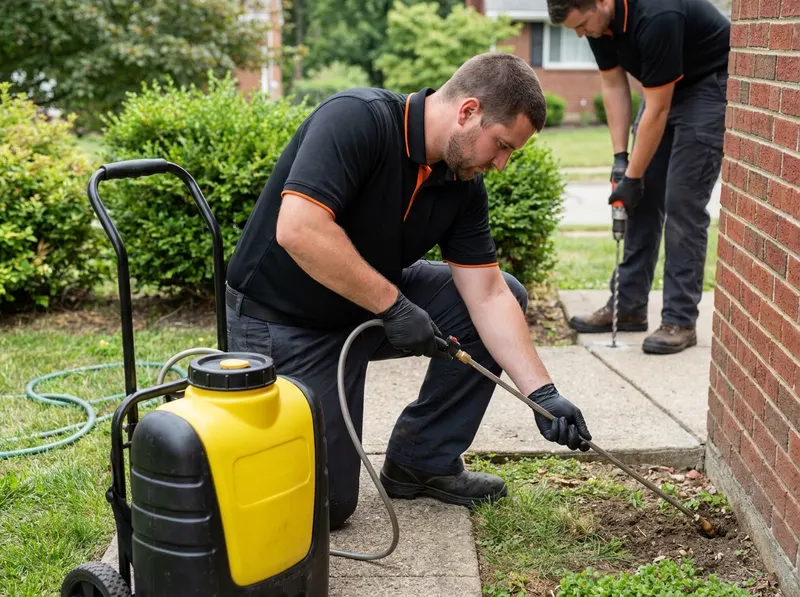
Subterranean termite infestations in Allegheny County predominantly involve Reticulitermes flavipes, a species that travels through subterranean mud tubes to consume structural cellulose. In neighborhoods such as Shadyside, Squirrel Hill, and Highland Park, historic residential architecture frequently features fieldstone foundations and porous lime mortar. Non-repellent liquid barrier defense binds to the backfill soil surrounding these footers. Because worker termites cannot detect the agent, they pass through treated ground, transfer the chemical across the colony via social grooming, and eliminate the nest without forcing chemical aerosols into indoor living quarters.
Industrial and rowhouse typography throughout Lawrenceville, the South Side Flats, and Bloomfield introduces complex boundary conditions where exterior soil access is limited by abutting concrete walks or shared party walls. In these conditions, technicians perform targeted concrete slab drilling at 12-inch intervals along basement floors or entry slabs to inject the liquid barrier directly into underlying soil aggregate, complying with EPA termite management protocols. This technique protects structural floor joists and basement sill plates that sit near grade level against river valleys and hillside seepage zones.
Property structures located on sloped topographies, such as Mount Washington and Brookline, experience concentrated soil hydrodynamics that demand calculated chemical dilution ratios regulated by the Pennsylvania Department of Agriculture. Technicians trench continuous 6-inch by 6-inch channels along exposed earth perimeters, backfilling each section with treated soil to sustain continuous chemical saturation. For high-density retail corridors in East Liberty and the Strip District, perimeter liquid barriers offer long-term residual integrity without relying on above-ground wooden monitoring stations that require frequent site re-entry.
Executing subterranean termite elimination requires a three-step perimeter process: 1. Technicians probe interior basement load points, band joists, and mud tunnels to identify entry vectors and measure exterior linear perimeters. 2. Specialists dig perimeter trenches in accessible soil and drill small clearance holes through adjoining exterior concrete slabs or stone porches. 3. Operators inject non-repellent liquid solutions at precise pressures into the soil layers and seal all drill penetrations with hydraulic cement to secure structural protection.
Every job gets a firm, written price after a free on-site visit.
Tell us about your subterranean termite treatment and liquid barrier defense job in Pittsburgh and we'll send a clear, written quote, usually the same day.
 Nexford Pest Solutions